What Are the Top Types of Solar Panel Systems for Home?
Choosing a Solar Panel System Home is no longer a simple question of buying rooftop panels. Homeowners must compare system design, roof direction, battery storage, local weather, and electricity tariffs. A bright south-facing roof may suit a string inverter system. Partial shade may require microinverters or power optimizers. Homes with frequent outages may need a hybrid system with battery backup.
Industry data shows why these choices matter. The Solar Energy Industries Association and Wood Mackenzie reported that the United States installed approximately 6.8 gigawatts of residential solar capacity in 2023. The International Energy Agency’s Renewables 2024 report also identifies solar PV as the main driver of new renewable capacity worldwide. These figures demonstrate strong market momentum, but they do not guarantee equal savings for every household. Roof age, shading, financing costs, and export rules can change the result sharply.
Fatih Birol, Executive Director of the International Energy Agency, said, “Solar PV is going to be the single largest source of electricity generation worldwide by 2027.” His statement reflects solar’s expanding role, yet a home system still demands careful engineering. A battery can store afternoon production for evening cooking, while a grid-tied system may cost less without backup power. The cheapest option is not always the most resilient. That is easy to overlook. This guide compares monocrystalline, thin-film, grid-tied, off-grid, hybrid, and battery-integrated systems. It also considers installer qualifications, product warranties, degradation rates, and realistic household consumption, helping readers make a safer and more evidence-based decision.
Classify Home Solar Systems by Grid Access, Storage, Capacity, and Efficiency
Home solar systems are best classified by four practical questions: grid access, storage, capacity, and efficiency. A grid-tied system sends excess electricity to the utility network. It usually costs less, but it stops during outages without backup equipment. A hybrid system adds batteries and intelligent controls. An off-grid system needs batteries and often a generator. It also requires careful winter planning. One cloudy week can expose an optimistic design.
Storage changes the system’s purpose. A battery measured in kWh shifts evening loads, while an inverter measured in kW limits simultaneous appliances. For example, a 10 kWh battery may run lights and refrigeration overnight, but not a large electric heater for long. NREL’s U.S. Solar Photovoltaic System and Energy Storage Cost Benchmarks reported residential PV-plus-storage costs near $4.50 per watt in its Q1 2023 benchmark. Local labor and permitting can differ sharply. Cost comparisons need context.
Capacity should follow annual consumption, roof area, shading, and export rules. A 6 kW array may suit a modest home, while high-load homes may need 10 kW or more. These are starting points, not promises. Efficiency has two layers: panel conversion and whole-system yield. Fraunhofer ISE’s Photovoltaics Report 2024 places mainstream module efficiency roughly between 20% and 23%. Temperature, dust, wiring, and inverter losses reduce delivered energy. IEA PVPS reported global PV capacity above 1.4 TW by the end of 2023, showing scale, not equal household performance. I would verify one overlooked detail: winter output. It often decides whether a system feels reliable.
What Are the Top Types of Solar Panel Systems for Home?
Residential solar systems can be classified by grid access, battery storage, system capacity, and photovoltaic module efficiency. The chart shows representative planning values for common home system configurations.
Grid-tied systems usually have no battery and use the utility grid when solar production is low. Hybrid systems remain connected to the grid while adding battery backup. Off-grid systems require larger storage because they cannot rely on the utility grid. Capacity and efficiency vary with household demand, roof space, climate, and equipment selection; the values shown are representative residential benchmarks rather than fixed requirements.
Grid-Tied PV: Compare 15–25% Module Efficiency and Net-Metering Models
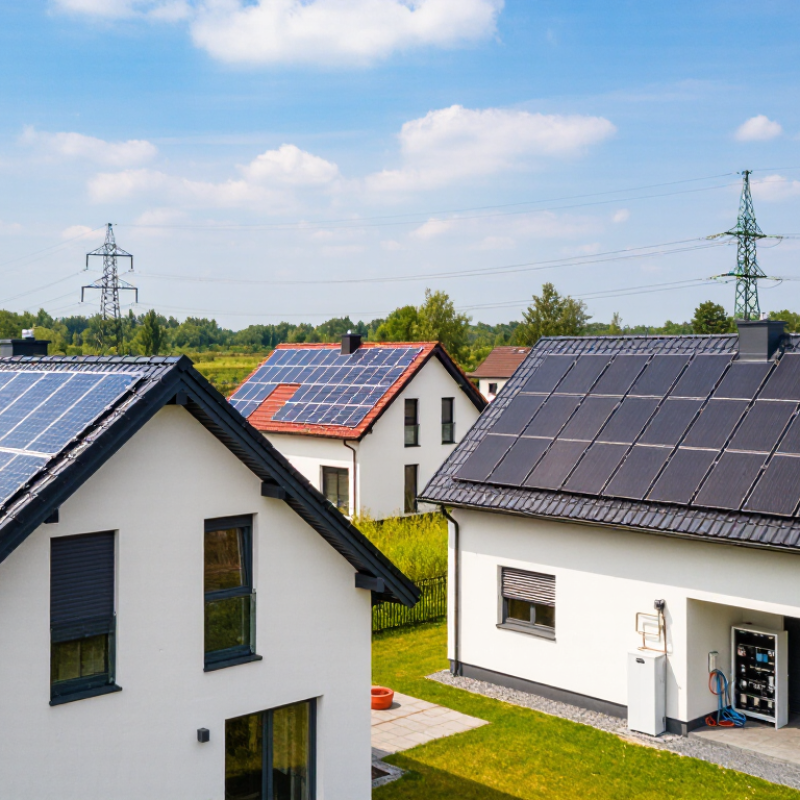
Grid-tied photovoltaic systems remain a practical choice for many homes. They connect rooftop panels to the utility network through an inverter. When panels produce more electricity than the household uses, the excess flows to the grid.
Module efficiency commonly ranges from 15% to 25%. A 15% module may need more roof space for the same output. A 25% module can help when the roof is small, shaded, or partly obstructed. Efficiency alone does not predict annual savings. Orientation, local sunlight, temperature, inverter losses, and dust also matter. Real roofs are rarely perfect.
Net-metering rules change the financial picture.
Some utilities credit exported electricity near the retail rate. Others use an avoided-cost rate, which may be much lower. Buy-all, sell-all plans use separate prices for imported and exported power. Credits may expire monthly or annually. These details deserve careful checking before installation. A professional assessment should review twelve months of electricity bills, roof measurements, shading patterns, and utility tariffs.
A grid-tied system usually shuts down during a power outage. This protects utility workers, even when the sun is shining. Battery storage or specific backup equipment is required for outage power. One planning mistake is focusing only on panel efficiency. I have seen attractive production estimates weaken after shading and export limits were considered. Estimates should show assumptions, not just optimistic numbers. Ask for a production range and a clear explanation of every credit.
Off-Grid PV: Design for 2–3 Days of Battery Autonomy and Peak Loads
Off-grid photovoltaic systems must survive cloudy periods, not just produce energy on sunny days. A practical design usually stores two to three days of essential consumption. Begin with a measured load list, including refrigeration, water pumps, lighting, communication equipment, and heating controls. Daily energy use and peak demand are different numbers. A pump may run briefly but draw several times more power than a lamp.
Battery capacity should include usable depth, cold-weather effects, conversion losses, and gradual ageing.
For example, a home using 8 kWh daily may need more than 24 kWh of nominal storage for three days. Local winter sunlight matters greatly. An array sized for summer can underperform badly in December. The inverter must also handle starting surges from motors and compressors. Purely matching its continuous rating is risky. I have seen otherwise careful calculations fail because a freezer’s start-up current was ignored. Paper designs can be too optimistic.
Tips:
Separate critical and flexible loads with a simple energy schedule. Keep essential circuits powered during low battery conditions. Leave room for future battery expansion. Check cable length, ventilation, temperature, and maintenance access before installation. A backup generator may improve resilience, but fuel storage and operating rules require careful planning. Review real energy data after several months, then adjust the system instead of trusting every original assumption.
Hybrid PV Plus Storage: Evaluate 5–20 kWh Batteries for Backup Resilience
Hybrid PV-plus-storage systems combine rooftop solar with a battery and grid connection. They can keep essential circuits operating during outages, but sizing requires more than guessing monthly usage. The U.S. Energy Information Administration reported average residential electricity consumption of about 899 kWh monthly in 2022, or roughly 30 kWh daily. A 5–20 kWh battery therefore supports selected loads, not an entire home indefinitely.
A 5 kWh system may cover lighting, internet equipment, refrigeration, and phone charging overnight. A 10 kWh system offers stronger resilience for a gas furnace fan, medical equipment, or a small heat pump. At 20 kWh, households can extend backup into the next day, especially when solar production resumes. Usable capacity matters. A practical design may reserve 10% for battery protection and allow for conversion losses. Weather still changes the result.
NREL’s PVWatts guidance shows that solar output depends heavily on roof orientation, shading, season, and local weather. The International Energy Agency also identifies battery storage as increasingly important for integrating distributed solar. Yet more capacity is not automatically better. A large battery can remain underused, while a small one may fail during a cloudy outage. Ask an installer to model critical-load hours, winter production, battery degradation, and automatic transfer behavior. Test the system before an emergency. Many homeowners overlook that step.
What Are the Top Types of Solar Panel Systems for Home? - Hybrid PV Plus Storage: Evaluate 5–20 kWh Batteries for Backup Resilience
| Hybrid System Tier |
Nominal Battery Capacity |
Estimated Usable Capacity |
Recommended Solar PV Size |
Typical Inverter Rating |
Suitable Backup Loads |
Approximate Runtime at 500 W Average Load |
Typical Clear-Sky Recharge Time |
Best Use Case |
| Essential Backup |
5 kWh |
Approximately 4.5 kWh |
2–4 kW |
3–5 kW |
Refrigerator, lighting, internet equipment, small electronics, and selected outlets |
About 8–9 hours |
About 1 sunny day under favorable conditions |
Short outages, essential household circuits, and lower energy consumption homes |
| Balanced Home Backup |
10 kWh |
Approximately 9 kWh |
4–7 kW |
5–8 kW |
Essential circuits plus a furnace blower, larger refrigeration loads, communications equipment, and limited kitchen appliances |
About 17–18 hours |
About 1 sunny day, depending on household consumption |
A practical balance between backup duration, solar production, and system cost |
| Extended Backup |
15 kWh |
Approximately 13.5 kWh |
5–9 kW |
6–10 kW |
Most essential circuits, refrigeration, lighting, networking, heating controls, and intermittent use of larger appliances |
About 26–27 hours |
About 1–2 sunny days |
Multi-day outage protection for medium-sized homes with controlled energy use |
| High-Resilience Backup |
20 kWh |
Approximately 18 kWh |
7–12 kW |
8–12 kW |
Most household essentials, multiple refrigeration loads, heating equipment, home office equipment, and selected high-starting-current appliances |
About 35–36 hours |
About 2–3 sunny days |
Longer outages, larger homes, colder climates, and households requiring stronger backup resilience |
Planning assumptions: Usable capacity is estimated at 90% of nominal battery capacity to allow for operating reserves and battery management limits. Runtime estimates assume a steady 500 W average load and do not include unusually high starting currents from motors, electric resistance heating, electric water heating, or vehicle charging. Actual performance depends on local solar conditions, roof orientation, seasonal sunlight, inverter efficiency, battery temperature, demand patterns, and whether the system uses a critical-loads panel or whole-home backup.